Compare
Warm Roof vs Glass Conservatory Roof: Which Is Right for You? (2026)
Warm roof or glass conservatory roof? Compare insulation, light, noise, cost, lifespan and resale value to choose the right replacement roof for your home.
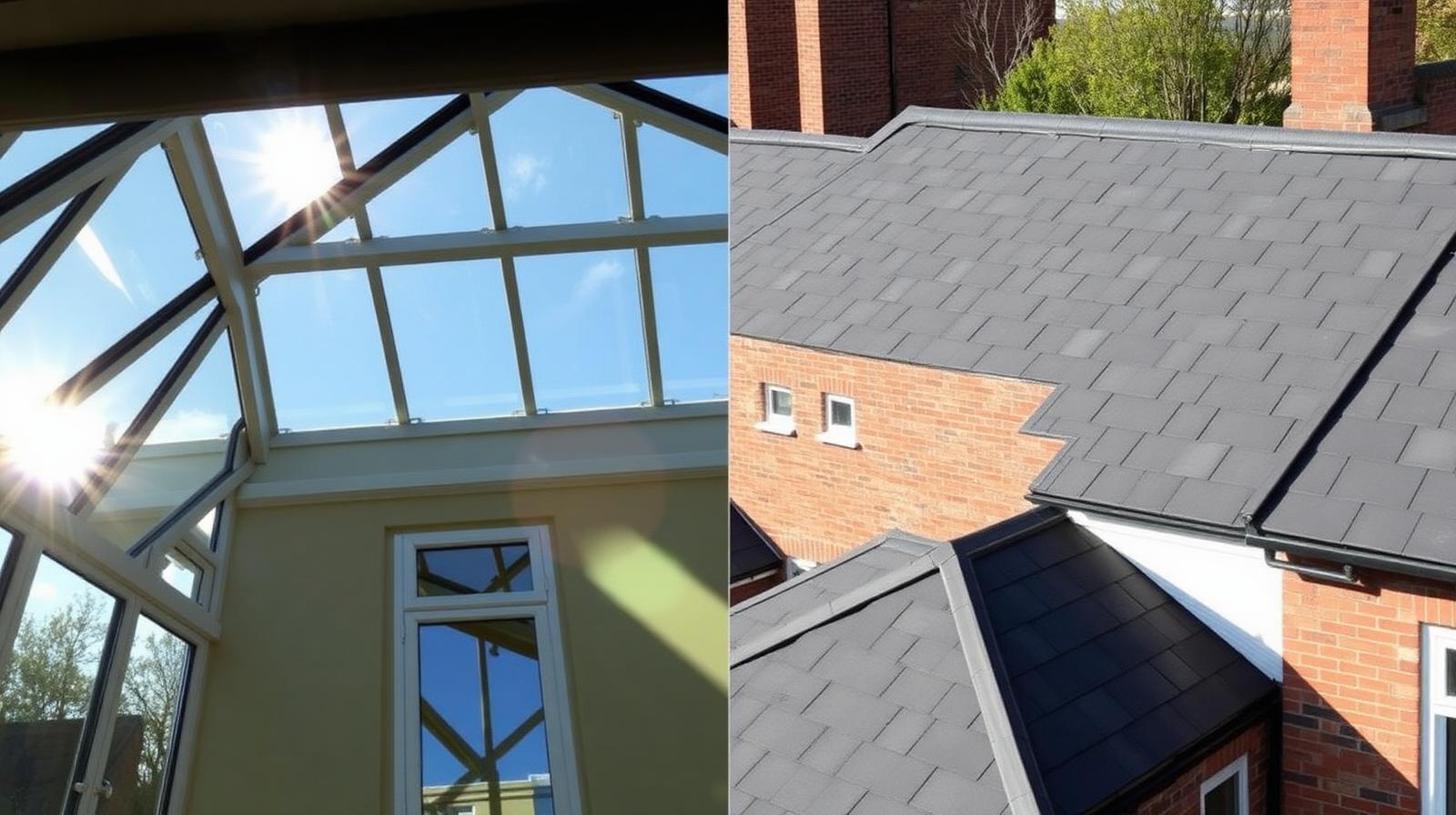
If you're replacing a tired conservatory roof, the big choice is an insulated warm roof or a new glass roof. Both are valid — and the right answer depends on how you actually use the room. This guide compares them on every dimension that matters.
Side-by-side: warm roof vs glass roof
| Warm roof | Glass roof | |
|---|---|---|
| Typical fitted price | £5,500 – £11,500 | £3,000 – £6,000 |
| U-value (lower = better) | ~0.15 W/m²K | ~2.0 W/m²K |
| Comfortable in summer | Yes — no greenhouse effect | No — overheats badly |
| Comfortable in winter | Yes — holds heat | No — heat escapes upward |
| Rain noise | Silent | Loud, especially polycarbonate |
| Overhead daylight | Reduced (Velux fixes this) | Maximum |
| Lifespan | 25+ years | 10–15 years before re-sealing |
| Building regulations | Required (we handle it) | Not required |
| Adds resale value | Yes — habitable square footage | Limited |
The detailed comparison
Glass conservatory roof
- Pros: maximum natural light, modern look, lower upfront cost
- Cons: hot in summer, cold in winter, rain is loud, condensation can be bad, gaskets need re-sealing every 8–12 years
- Best for: homeowners with decent shade, who only use the room occasionally, or where the existing frames couldn't take the (small) extra weight of a tiled roof
Warm (insulated tiled) roof
- Pros: usable year-round, dramatic drop in heating bills, silent in heavy rain, looks like a proper extension. We fit the SupaLite warm roof system exclusively.
- Cons: less overhead light (we add Velux windows where it makes sense), higher upfront cost — see our cost guide
- Best for: anyone who wants the conservatory to function as a real room — dining room, snug, home office, playroom, second living room
What about light? (The number one worry)
This is the worry we hear most often. Two things to know:
- The side windows of a conservatory are still glass — they're where most of your usable daylight comes from anyway. The roof mostly contributes glare and heat, not the kind of light you read or work by.
- Roof windows (Velux) can be designed in. Two well-placed roof windows give you beautiful, controllable daylight without the greenhouse effect — the best of both worlds. Most warm roof customers add at least one.
Comfort vs cost — the long view
A new glass roof is cheaper on day one but doesn't solve the temperature problem (too hot in summer, too cold in winter). A warm roof costs more upfront but pays back through energy savings and — more importantly — by giving you a room you'll actually use 12 months a year.
Over a 10-year window, the cumulative cost is often lower with a warm roof once you factor in heating bills, replacement gaskets, sun damage to furniture, and the fact that a properly insulated conservatory adds noticeably more to your property's resale value.
Which roof for which lifestyle?
- "We use it as a dining room year-round": warm roof, every time. Two Velux for daylight at meals, plastered ceiling with downlighters.
- "It's my home office": warm roof. The temperature stability and reduced screen glare alone justify it.
- "We just sit out in summer evenings": a glass roof refurbishment may be enough — particularly if shade is good.
- "It's an indoor garden / plant room": stick with glass. Plants want the light.
Common mistakes to avoid
- Worrying too much about overhead light. Side windows do the heavy lifting. Add a Velux or two and the room is bright without being a furnace.
- Comparing only the upfront price. The cheaper roof on day one is almost always more expensive over 10 years.
- Forgetting building regulations on warm roofs. A non-compliant warm roof is a liability when you sell. Always go with an installer who manages LABC sign-off.
- Patching a failing glass roof again. If you've already paid for re-sealing once or twice, the next failure is usually months away. A warm roof is the fix.
Energy performance: the numbers behind "warm"
The reason a warm roof feels so different from a glass roof isn't marketing — it's physics. The U-value of a roof tells you how much heat it loses per square metre per degree of temperature difference between inside and outside. Lower is better.
- Single-glazed glass roof: ~5.0 W/m²K
- Modern double-glazed glass roof (argon-filled, soft-coat low-E): ~1.6–2.0 W/m²K
- Polycarbonate roof (25 mm): ~2.5 W/m²K
- SupaLite™ insulated warm roof: ~0.15 W/m²K
- Modern house extension roof: ~0.18 W/m²K (current building reg minimum)
A SupaLite™ warm roof is roughly 10–13× more thermally efficient than the best modern glass roof and actually exceeds the building regulation minimum for new house extensions. That's why your conservatory stops feeling like a different room from the rest of the house — because thermally, it isn't.
Solar gain and what really happens in summer
Even the best self-cleaning, blue-tinted, solar-control glass still lets a significant amount of solar energy through. On a south-facing Plymouth conservatory in July, surface temperatures inside a glass roof can reach 45–55°C. By comparison, the underside of a SupaLite™ insulated ceiling typically sits within 2–3°C of the rest of the house — even on the hottest day of the year.
That isn't theoretical. We've taken thermal-camera readings on dozens of completed jobs across Plymouth, Plymstock and Saltash, and the pattern is consistent: the warm roof ceiling tracks the indoor air temperature; the glass roof ceiling tracks the outside sun.
Rain noise: the underrated upgrade
If you've ever tried to hold a phone call, watch TV or simply have a conversation in a polycarbonate-roofed conservatory during a typical Devon downpour, you already know the problem. Polycarbonate is essentially a drum: every raindrop is amplified.
Glass is significantly quieter than polycarbonate, but still much louder than a tiled roof. A SupaLite™ warm roof, with its insulation layer, plasterboard and plaster ceiling, is essentially silent in heavy rain. We've had multiple customers tell us that the first time they noticed the new roof wasn't visually — it was during the next big rainstorm, when they realised they couldn't hear it.
Condensation, damp and mould
Glass roofs cause condensation for one simple reason: the inside surface of the glass is cold, and warm humid indoor air condenses on it. Over winter, that water runs down onto frames, soaks into seals and eventually causes:
- Black mould around the glazing bars
- Dripping ceilings on cold mornings
- Saturated curtains and blinds
- Failed double-glazed units (misting between panes)
A warm roof solves this at the root. Because the inside surface of the ceiling is warm — close to indoor air temperature — there's no cold surface for moisture to condense on in the first place. Condensation in the conservatory drops to roughly the same level as the rest of the house.
Lifespan, maintenance and warranty
| Cost / event | Glass roof | Warm roof (SupaLite™) |
|---|---|---|
| Initial install | £3,500 (typical) | £8,500 (typical) |
| Gasket re-seal at year 8–12 | £600 – £1,200 | Not required |
| Failed sealed unit replacement (typical) | £200 – £400 per panel | n/a |
| External cleaning (annual) | £60 – £120 | Optional, ~£40 |
| Heating bill impact (15 years) | +£3,000 – £5,000 | Baseline |
| End-of-life roof refurbishment | Likely required | Not required at 15 years |
| Warranty coverage | Usually 5 years | 10 years insurance-backed |
The "will it look right on my house?" worry
This is the second most common concern after light. The honest answer: it depends on the conservatory shape, the colour of your existing roof tiles and your preference. We bring physical tile samples to every survey so you can hold them against your house before deciding. Most customers go with one of three combinations:
- Anthracite slate-effect — modern, clean look, suits 1990s-onwards homes (the most popular choice in central Plymouth and Plymstock).
- Charcoal slate-effect — pairs well with grey UPVC frames and slate-roofed houses across the South Hams.
- Terracotta tile-effect — best on older brick-built homes, character properties around Saltash and east Cornwall.
Hybrid options: the "lantern" solution
Worried about losing all your overhead light? A popular hybrid we're fitting more often in 2026 is a SupaLite™ warm roof with a central glazed roof lantern. You get the thermal performance of a fully insulated roof around the perimeter, plus a fixed glass lantern over the central living area for a "sky cathedral" effect. Not cheap — typically £2,000–£3,500 on top of the standard warm roof — but stunning on Edwardian and orangery- style conservatories.
Resale value and how surveyors treat each roof
We talk to local Plymouth estate agents and RICS surveyors regularly. Their consistent view is that:
- A glass-roofed conservatory is treated as a "summer room" and adds limited value — sometimes none, especially if it's old or in poor condition.
- A warm-roofed conservatory with building regulation sign-off is increasingly counted as habitable square footage, and adds proportional value.
- Without sign-off paperwork, even a beautifully built warm roof can be downgraded by a surveyor — which is why our quotes always include LABC sign-off and a completion certificate.
Decision framework: a 60-second self-test
Answer these five questions honestly:
- How many months of the year do you currently use the conservatory comfortably?
- Does your existing roof leak, mist or condensate in winter?
- Is the room too hot to use on a sunny afternoon between May and September?
- Do you want this room to function as a "real" living space (dining room, snug, office)?
- Are you planning to stay in the house at least 5 years, or sell it within the next 1–2?
If you said "fewer than 8 months", "yes", "yes", "yes" and "staying" — go warm roof, every time. If your answers are "year-round", "no", "no", "occasional use" and "selling soon" — a glass roof refurbishment may be enough. Most Plymouth customers fall firmly in the warm roof camp.
Our honest recommendation
If you've ever said "we don't really use the conservatory" — go warm roof. If the existing roof is leaking but the room is comfortable, a targeted leak repair or glass replacement may be enough. We'll tell you straight at the survey — book one here. For full pricing context, see our conservatory roof cost guide.
Frequently asked questions
Is a warm roof better than a glass roof?
For year-round usability, yes. A warm roof keeps the conservatory comfortable in winter and summer, reduces heating bills and eliminates rain noise. A glass roof gives more overhead light but fails on temperature control.
Will a warm roof make my conservatory dark?
Not if it's designed properly. Most natural light comes from your side windows, not the roof. We add Velux roof windows where it makes sense, giving you controllable daylight without the greenhouse effect.
Can I keep my existing conservatory frames with a warm roof?
In most cases, yes. The SupaLite warm roof system is lightweight enough to sit on existing UPVC or aluminium conservatory frames. We always survey first to confirm.
How long does a warm roof last vs a glass roof?
A SupaLite warm roof is built to last 25+ years and comes with a 10-year insurance-backed guarantee. Glass roof seals typically need replacing every 10–15 years.
Is a glass roof cheaper to maintain?
No. Glass roofs need regular cleaning, gasket re-sealing every 8–12 years and panels can fail individually. Warm roofs are essentially maintenance-free for the life of the system.
Do warm roofs increase house value more than glass?
Generally yes. Surveyors and estate agents are more likely to count a warm-roof conservatory as habitable square footage, particularly if it has building regulation sign-off.
Free, no-pressure quote on your conservatory roof
Based in Plymouth — covering Devon & Cornwall. 10-year insurance-backed guarantee.
Ready to Transform Your Conservatory?
Get a free, no-obligation quote for your conservatory roof replacement. We'll visit your home, assess your conservatory, and provide a detailed written quote.
No pushy sales · Same-day reply · 10-year insurance-backed guarantee
Get your free quote
Tell us a little about your conservatory and we'll come back to you within 48 hours. No pushy sales, no obligation.