Comfort
What Makes a Tiled Conservatory Roof Better for Noise Reduction
Why a tiled conservatory roof dramatically reduces rain, wind and traffic noise compared to glass or polycarbonate — the science, the difference and what to expect.
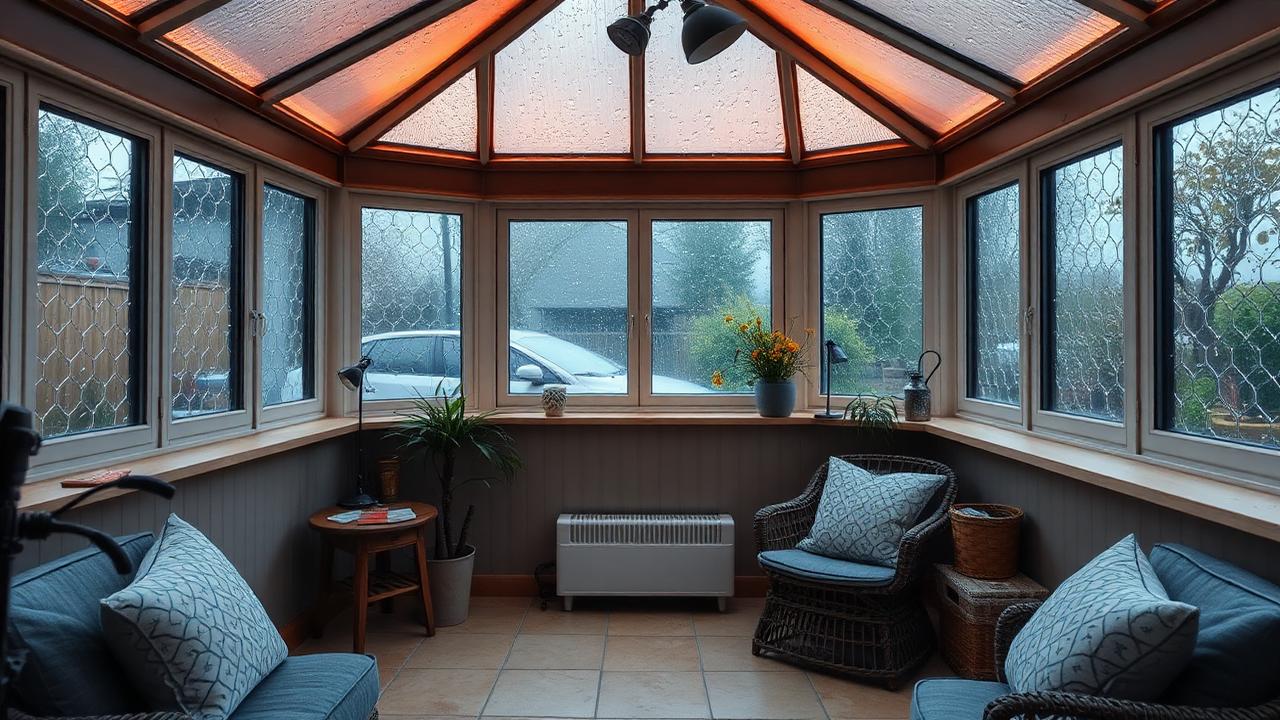
If your conservatory turns into a snare drum every time it rains in Plymouth — and our weather gives it plenty of practice — the roof is the reason. Glass and polycarbonate panels resonate; tiles don't. Here's the science behind why a tiled warm roof is so dramatically quieter, and what kind of difference you'll actually hear.
Why polycarbonate is so loud
Polycarbonate is thin, light and rigid — exactly the properties that make a drum skin loud. Every raindrop hits the panel and the energy radiates straight into the room with almost nothing to absorb it. Heavy rain on polycarbonate routinely measures 75–80 dB inside the conservatory, which is loud enough to make TV or conversation difficult.
Why glass is better — but not great
Glass is heavier than polycarbonate, so it absorbs more impact energy. But the sealed double-glazed unit still resonates, and the gaps between panels let some noise through. Heavy rain on a glass roof typically measures around 60–65 dB inside — better, but still loud enough to dominate the room.
Why a tiled warm roof is so quiet
Three things work together:
- Mass — the tiles themselves are far heavier per square metre than glass or polycarbonate, so each raindrop loses most of its energy on impact.
- Insulation — the foam or mineral wool layer between the tiles and the inner ceiling absorbs whatever noise gets through the tiles.
- Plasterboard ceiling — the final solid surface acts as a decoupled barrier, the same way it does in any normal room of your house.
The result: heavy rain on a SupaLite tiled roof typically measures around 45–50 dB inside — about the same as quiet conversation, and comparable to any other room of the house.
How the roof types compare
| Roof type | Indoor noise level | Comparable to |
|---|---|---|
| Polycarbonate | ~75–80 dB | Busy main road / vacuum cleaner |
| Sealed glass units | ~60–65 dB | Office background / dishwasher |
| SupaLite tiled warm roof | ~45–50 dB | Quiet conversation / library |
Wind, traffic and aircraft noise
Rain is the most obvious win, but the same principle applies to other sources:
- Wind: a tiled roof has no resonant panels to vibrate, so the wind passes silently.
- Traffic: particularly higher-frequency noise drops noticeably — useful for homes near busy roads.
- Aircraft: the difference is less dramatic but still meaningful, especially during overhead passes.
The unexpected benefit
Most customers come to us about heat or condensation. The noise reduction is the unplanned bonus they tell us about a month later — finally being able to read, work or watch TV in heavy rain instead of giving up and going to another room. See our wider guide on warm roof vs glass for how the two systems compare across all the comfort factors.
Will I lose Wi-Fi or TV signal?
No — this is the most common question we get when noise reduction comes up. SupaLite tiled roofs are non-metallic; they don't act as a Faraday cage and Wi-Fi, 4G/5G, satellite and DAB signals all pass through without measurable attenuation. A handful of customers actually report better signal because the tiles also block some interference from neighbouring properties.
Acoustic comfort beyond rain
Once the roof stops being the loudest surface in the room, you start noticing small acoustic improvements you'd never have predicted:
- Conversations no longer feel "echoey" — solid plasterboard ceiling absorbs reflection.
- TV and music sound noticeably warmer, especially bass response.
- You stop unconsciously raising your voice during heavy rain.
- The room becomes usable as a home office — see our adapting conservatories guide.
Plymouth-specific noise sources
Conservatories near the city centre, the A38, or under flight paths into Exeter deal with a unique noise mix. The areas where we get the most noise-related replacement enquiries:
- Plymouth city centre and Mutley — traffic and weekend noise.
- Plympton and Ivybridge — A38 corridor.
- Plymstock and Saltash — coastal wind plus rain.
What you can do without replacing the roof
If full replacement isn't on the cards yet, two interim measures help — neither is a fix, but both reduce the perceived loudness:
- Heavy curtains or roller blinds across the conservatory roof. Soft surfaces absorb reflected noise, dropping perceived volume by 5–8 dB.
- A thick rug on the floor and upholstered furniture. Sounds obvious, but a tiled or laminate-floored conservatory amplifies every drum beat the roof produces.
These are sticking-plaster fixes. The actual problem is the roof — see our insulated tiled conservatory roofs page for the permanent solution.
Get a free survey
Want to know how loud your existing roof actually is and what a tiled replacement would do? Request a free survey. We cover Plymouth, Plymstock, Saltash, Ivybridge, Devon and Cornwall.
Frequently asked questions
Is a tiled conservatory roof quieter than a glass roof?
Yes, dramatically. A tiled warm roof reduces rain noise by roughly 30 decibels compared to polycarbonate — moving from 'unbearable in heavy rain' to 'barely noticeable'. Glass roofs sit roughly halfway between the two.
How much rain noise will I still hear with a tiled roof?
About the same as in any other room of your house. The combination of mass (tiles), insulation and the inner plasterboard ceiling kills the drum effect that makes polycarbonate roofs so loud.
Does a tiled roof reduce wind noise too?
Yes. Glass and polycarbonate panels resonate in strong wind — a SupaLite roof is a single sealed structure with no resonant panels, so the wind passes silently over it.
Will it block traffic or aircraft noise?
It significantly reduces both, particularly higher-frequency noise. The effect isn't as dramatic as for rain (which hits the roof directly), but most customers say the room feels noticeably more peaceful.
Is the noise reduction the main reason people choose tiled roofs?
It's one of the top three, alongside thermal comfort and condensation. Many customers tell us they finally use the conservatory in winter — partly because it's warm, partly because it's no longer a deafening room every time it rains.
Are some tiled roof systems quieter than others?
Yes — proper insulation thickness and a plastered ceiling on plasterboard make a significant acoustic difference. The SupaLite system we fit is engineered with both.
Free, no-pressure quote on your conservatory roof
Based in Plymouth — covering Devon & Cornwall. 10-year insurance-backed guarantee.
Ready to Transform Your Conservatory?
Get a free, no-obligation quote for your conservatory roof replacement. We'll visit your home, assess your conservatory, and provide a detailed written quote.
No pushy sales · Same-day reply · 10-year insurance-backed guarantee
Get your free quote
Tell us a little about your conservatory and we'll come back to you within 48 hours. No pushy sales, no obligation.